Search for a full or partial Catalog Number, CAS Number or description
Your favorites Quick Order Form
Your cart is empty.
Home Catalog New Products Custom Synthesis & CGMP Product Resources About
Contact Strem

CAS Number: 2809-21-4
Product Catalog

15-2900
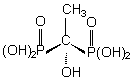
Phosphorus 1-Hydroxyethylidene-1,1-diphosphonic acid, min. 95% HEDP
CAS Number: 2809-21-4
MDL Number: MFCD00070585
Molecular Formula: C2H8O7P2
Molecular Weight: 206.03
Chemical Formula: C(OH)(CH3)(PO3H2)2
Color and Form: white pwdr.
Note:  
15-2900

Please log in or choose your country below to view prices.

Choose Your Country

SECTION 1: Product Identification
Chemical Name: 1-Hydroxyethylidene-1,1-diphosphonic acid, min. 95% HEDP
Product Number: 15-2900
CAS Registry Number: 2809-21-4
Formula: C(OH)(CH3)(PO3H2)2
EINECS Number: none
Chemical Family: organophosphorus compound
Synonym: Ethane-1-hydroxy-1,1-diphosphonate, 1,1,1-Ethanetriol diphosphonate
SECTION 2: Composition and Information on Ingredients
Ingredient CAS Number Percent ACGIH (TWA) OSHA (PEL)
Title Compound 2809-21-4 100 no data no data
SECTION 3: Hazards Identification
Emergency Overview: Acidic material. Dust is a severe irritant to skin, eyes and respiratory tract. Possible risk of harm to the unborn child.
Primary Routes of Exposure: Ingestion, eyes, inhalation
Eye Contact: Severe acidic irritant to the eyes. Exposure can lead to permanent eye damage.
Skin Contact: Causes moderate irritation of the skin.
Inhalation: The dust is severely irritating to the nose, mucous membranes and respiratory tract.
Ingestion: May cause burns, vomiting and diarrhea if ingested.
Acute Health Effects: Severe irritant to eyes, and respiratory tract. Causes irritation of the skin on prolonged exposure. Possible risk of harm to the unborn child.
Chronic Health Effects: The product has a high affinity for biological calcium and may accumulate in bone. Reproductive effector in animal studies.
NTP: No
IARC: No
OSHA: No
SECTION 4: First Aid Measures
Eye Exposure: Immediately flush the eyes with copious amounts of water for at least 10-15 minutes. A victim may need assistance in keeping their eye lids open. Get immediate medical attention.
Skin Exposure: Wash the affected area with water. Remove contaminated clothes if necessary. Seek medical assistance if irritation persists.
Inhalation: Remove the victim to fresh air. Closely monitor the victim for signs of respiratory problems, such as difficulty in breathing, coughing, wheezing, or pain. In such cases seek immediate medical assistance.
Ingestion: Seek medical attention immediately. Keep the victim calm. Give the victim water (only if conscious). Induce vomiting only if directed by medical personnel.
SECTION 5: Fire Fighting Measures
Flash Point: not applicable
Autoignition Temperature: no data
Explosion Limits: no data
Extinguishing Medium: carbon dioxide, dry powder, foam, or water
Special Fire Fighting Procedures: Fire fighters should be equipped with a NIOSH approved positive pressure self-contained breathing apparatus and full protective clothing.
Hazardous Combustion and Decomposion Products: If involved in a fire this material may emit toxic organic fumes, carbon monoxide, and phosphorous oxides.
Unusual Fire or Explosion Hazards: No unusual fire or explosion hazards.
SECTION 6: Accidental Release Measures
Spill and Leak Procedures: Small spills can be neutralized with sodium carbonate, sodium bicarbonate or lime. The solids can then be swept up and properly disposed of.
SECTION 7: Handling and Storage
Handling and Storage: Store in a tightly sealed container. Keep away from heat and direct sunlight.
SECTION 8: Exposure Controls and Personal Protection
Eye Protection: Always wear approved safety glasses when handling a chemical substance in the laboratory.
Skin Protection: Wear protective clothing and gloves. Consult with glove manufacturer to determine the proper type of glove.
Ventilation: Material may form a fine dust. Work with this product in a well-ventilated area, preferably a fume hood.
Respirator: If ventilation is not available a respirator should be worn. The use of respirators requires a Respirator Protection Program to be in compliance with 29 CFR 1910.134.
Additional Protection: No additional protection required.
SECTION 9: Physical and Chemical Properties
Color and Form: white pwdr.
Molecular Weight: 206.03
Melting Point: no data
Boiling Point: no data
Vapor Pressure: no data
Specific Gravity: no data
Odor: none
Solubility in Water: very soluble
SECTION 10: Stability and Reactivity
Stability: air and moisture stable
Hazardous Polymerization: no hazardous polymerization
Conditions to Avoid: Contact with strong base
Incompatibility: oxidizing agents
Decomposition Products: carbon dioxide, carbon monoxide, organic fumes, and phosphorus oxides.
SECTION 11: Toxicological Information
RTECS Data: Oral (mouse); LD50: 1800 mg/kg. Intraperitoneal (mouse); TDLo: 40 mg/kg. Intraperitoneal (mouse); TDLo: 200 mg/kg. Intraperitoneal (mouse); TDLo: 200 mg/kg. Intraperitoneal (mouse); TDLo: 200 mg/kg. Subcutaneous (mouse); TDLo: 1400 mg/kg.
Carcinogenic Effects: no information available
Mutagenic Effects: no information available
Tetratogenic Effects: Possible reproductive effector
SECTION 12: Ecological Information
Ecological Information: No information available
SECTION 13: Disposal Considerations
Disposal: Dispose of according to federal, state, and local regulations.
SECTION 14: Transportation
Shipping Name (CFR): Non-hazardous
Hazard Class (CFR): NA
Additional Hazard Class (CFR): NA
Packaging Group (CFR): NA
UN ID Number (CFR): NA
Shipping Name (IATA): Non-hazardous
Hazard Class (IATA): NA
Additional Hazard Class (IATA): NA
Packaging Group (IATA): NA
UN ID Number (IATA): NA
SECTION 15: Regulatory Information
TSCA: Listed in the TSCA inventory.
SARA (Title 313): Title compound not listed.
Second Ingredient: none
Third Ingredient: none
SECTION 16: Other Information
Disclaimer: The information herein is believed to be accurate and reliable as of the date compiled. However, Strem Chemicals, Inc. makes no representation, warranty, or guarantee of any kind with respect to the information contained in this document or any use of the product based on this information.
Preparation Date: 5/14/2001
Revision Date: 2/02/2010

back to search results